Growing Demand for Off-Site Construction Is Driving Efficiency Upgrades in Concrete Equipment
Precast concrete is being used increasingly in residential buildings, public facilities, infrastructure projects, and modular construction. Compared with conventional cast-in-place construction, factory-based production moves more processes into a controlled environment. This can improve production planning, stabilize component quality, and shorten on-site construction schedules.
For overseas buyers, equipment selection for a precast plant is no longer based only on the purchase price of an individual machine. Buyers are paying more attention to whether the equipment can be integrated into the complete production process, including mold preparation, concrete placing, vibration, curing, demolding, tilting, handling, and quality inspection.
Against this backdrop, tilting tables are attracting attention because they can support the production of solid wall panels, sandwich wall panels, floor slabs, and other large flat precast concrete elements.
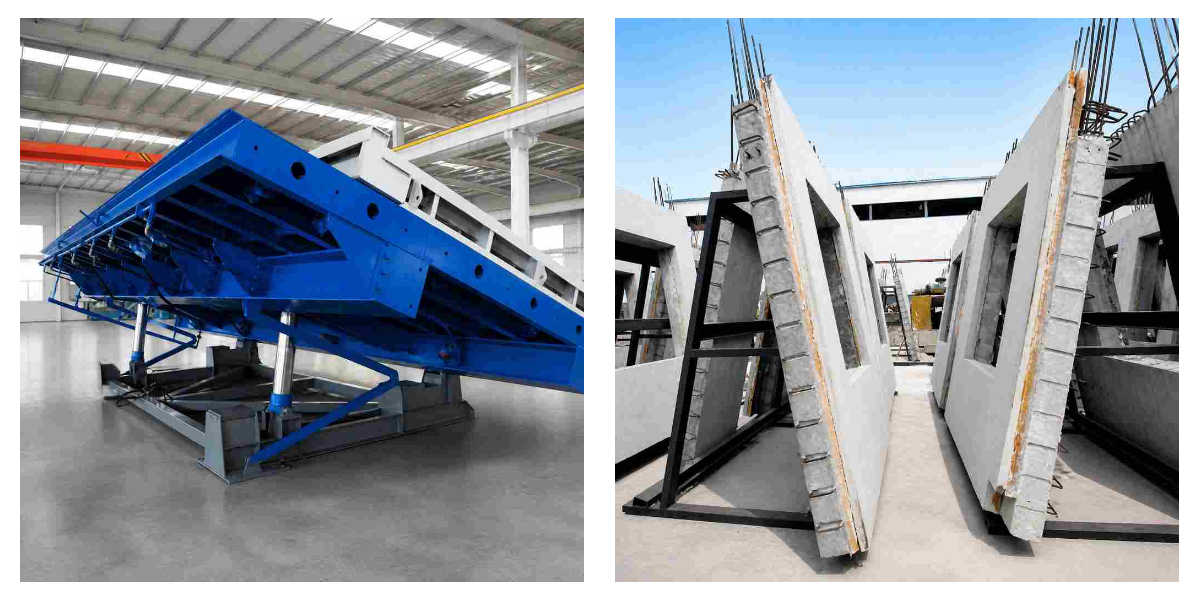
How Tilting Tables Improve Precast Production Efficiency
A precast concrete tilting table is commonly used for forming and demolding large flat concrete elements. With mechanical or hydraulic tilting, the equipment helps operators remove, transfer, and process elements in a safer and more consistent way, reducing the impact of manual operations on the production cycle.
For precast plants planning to expand capacity, the main benefits of tilting tables include:
Improved mold circulation. The table can be configured for different element specifications, helping plants improve floor-space utilization and mold turnover.
A more stable demolding process. Controlled tilting can help reduce the risk of impact or damage during demolding and minimize quality variations caused by inconsistent manual operations.
Compatibility with different elements. With an appropriate combination of the table surface, side forms, hydraulic system, and control system, one equipment solution can support precast elements of different sizes and structures.
Lower dependence on repetitive manual work. Semi-automatic or automatic tilting solutions can reduce physically demanding tasks and improve workplace safety.
Easier production-line integration. A tilting table can work with concrete distribution, vibration, curing, lifting, and logistics systems to support a more continuous production process.
Automation and Digitalization Are Becoming Key Purchasing Criteria
Publicly available industry information indicates that precast concrete production is moving from stand-alone automation toward coordinated production lines and data-driven management. The National Precast Concrete Association (NPCA) has noted that the use of artificial intelligence in precast manufacturing depends on the collection of production data. Digital data can support production optimization, quality control, equipment maintenance, and resource management.
This is changing how tilting tables are evaluated. Future equipment purchasing decisions are likely to focus more on the following capabilities:
stable and traceable control of tilting parameters;
connection with existing plant control or production-management systems;
fault alarms, operating records, and maintenance reminders;
customization for different element sizes, weights, and mold structures;
coordination with automatic lifting, conveying, and curing equipment;
clear installation, commissioning, spare-parts, and after-sales support.
For overseas projects, equipment suppliers need to provide more than the machine itself. Technical documentation, installation guidance, operator training, and remote support are becoming important parts of the purchasing decision.
Quality Control and Low-Carbon Manufacturing Are Influencing Equipment Upgrades
The quality consistency of precast concrete depends on raw materials, mix design, environmental conditions, mold accuracy, and production operations. Industry materials from NPCA indicate that digital and automated quality checks can help manufacturers reduce production waste and track sustainability-related indicators more systematically.
As a result, upgrading a tilting table is not only about automating the tilting movement. It also involves operating stability, mold positioning accuracy, safety protection, and maintenance convenience. Overseas buyers should review the following points:
flatness of the table surface and structural load capacity;
whether the tilting angle and operating speed can be adjusted;
hydraulic and electrical systems, safety limits, and emergency-stop functions;
mold fixing methods and compatibility with different product specifications;
manufacturing standards for welding, coating, corrosion protection, and key components;
replacement cycles for wear parts and after-sales response time.
When equipment helps reduce element damage, rework, and material waste, a plant can improve product consistency while using resources more efficiently per element. This is an important direction for the precision development of precast concrete equipment under the low-carbon construction trend.
What Should Overseas Buyers Consider When Choosing a Tilting Table?
For overseas buyers building or upgrading a precast production line, tilting tables should be evaluated across three dimensions: product requirements, plant workflow, and service delivery. Comparing only the initial purchase price may not reflect the actual long-term value of the equipment.
Industry Outlook: From Stand-Alone Equipment to Integrated Solutions
Recent industry cases show that precast manufacturers are adopting higher levels of automation to address capacity expansion, quality consistency, labor costs, and project delivery schedules. Reports from CPI Worldwide on precast and railway-sleeper production projects show that automated systems are moving toward high-volume, high-precision, intelligent control, and scalability. Reinforcement mesh welding and bending processes are also becoming more integrated and automated.
These developments suggest that tilting tables will increasingly be designed as part of a complete precast concrete production line rather than as isolated machines. Suppliers that can provide customized solutions based on product requirements, plant layout, capacity targets, and local electrical standards will be better positioned to meet overseas buyers’ expectations for reliable delivery and lifecycle service.
For concrete equipment manufacturers, the next stage of competition will not be limited to producing a reliable tilting table. It will also depend on whether they can help customers establish a safer, more efficient, maintainable, and scalable precast production system.
Frequently Asked Questions
What types of precast concrete elements can be produced with a tilting table?
Tilting tables are commonly used for solid wall panels, sandwich wall panels, floor slabs, and other large flat precast concrete elements. The final application range depends on element dimensions, weight, mold structure, and the load capacity of the equipment.
Can a tilting table improve precast production efficiency?
A properly configured tilting table can optimize demolding, tilting, and mold turnover, reduce repetitive manual operations, and help maintain a more stable production cycle. Actual results depend on product specifications, workflow, automation level, and the configuration of upstream and downstream equipment.
What information should overseas buyers provide when purchasing a tilting table?
Buyers should provide element dimensions, maximum weight, mold type, target capacity, tilting method, plant space, local power requirements, and whether the equipment must be integrated with an existing production line.
Can tilting tables be customized?
Most projects require customization based on element specifications, mold design, load requirements, tilting angle, hydraulic system, and control method. Technical drawings should be reviewed before purchase to confirm equipment boundaries and interfaces.
Are tilting tables suitable for automated production lines?
Yes. Depending on the project, tilting tables can be equipped with automatic controls, limit protection, operating records, and production-line interfaces. They can also be coordinated with lifting, conveying, concrete distribution, vibration, and curing systems.
Is price the most important factor when purchasing a tilting table?
Price is only one part of the purchasing decision. Equipment stability, mold compatibility, safety configuration, installation and commissioning, spare-parts supply, after-sales response, and long-term maintenance costs can all affect the actual return on investment.
Conclusion
Off-site construction, automated production, digital management, and low-carbon manufacturing are jointly driving upgrades across the concrete equipment industry. As an important part of the precast production process, the tilting table is evolving from a single tilting tool into a key connection between molds, demolding, handling, and production-line control.
For overseas buyers, the best approach is to evaluate a tilting table according to the target product and the complete production workflow. Suppliers with customized engineering, technical delivery, and long-term service capabilities are better positioned to support reliable precast production projects.


